On this page
Why hook and loop matters in automotive interiors
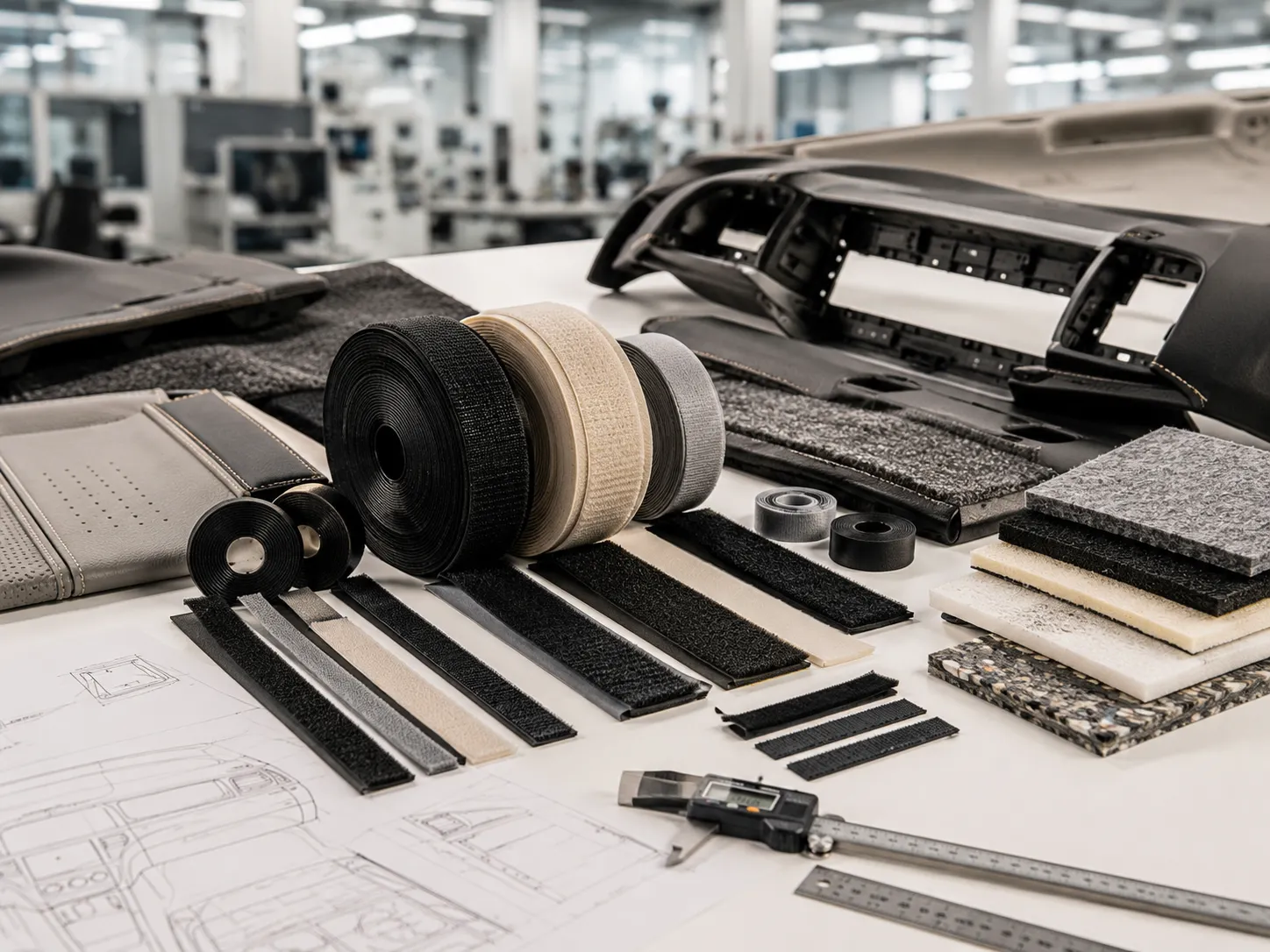
Automotive cabin assembly involves dozens of textile, foam and plastic components that must stay securely attached through years of vibration, temperature cycling and daily use. Hook and loop — also known as touch fastener or Velcro-style closure — provides a lightweight, repositionable alternative to clips, screws and permanent adhesives in many of these applications. Review our industry hook & loop guide for automotive interior programmes.
Unlike mechanical fasteners that can rattle, corrode or require tooling access, hook and loop distributes load across a textile interface and supports serviceable attachment. Seat trim covers can be opened for airbag access. Headliner layers can be fitted without heat staking. Carpet mats can be removed for cleaning. NVH insulation pads can be held in place without adding hard points that transmit noise.
For Tier-1 interior suppliers, hook and loop is both a material specification and a process decision. The textile construction affects cycle life and appearance. The adhesive backing determines bond durability on foam and plastic substrates. The attachment method — peel-and-stick or sew-on — shapes line layout and rework tolerance. Getting these variables right early prevents costly validation failures later in the program.
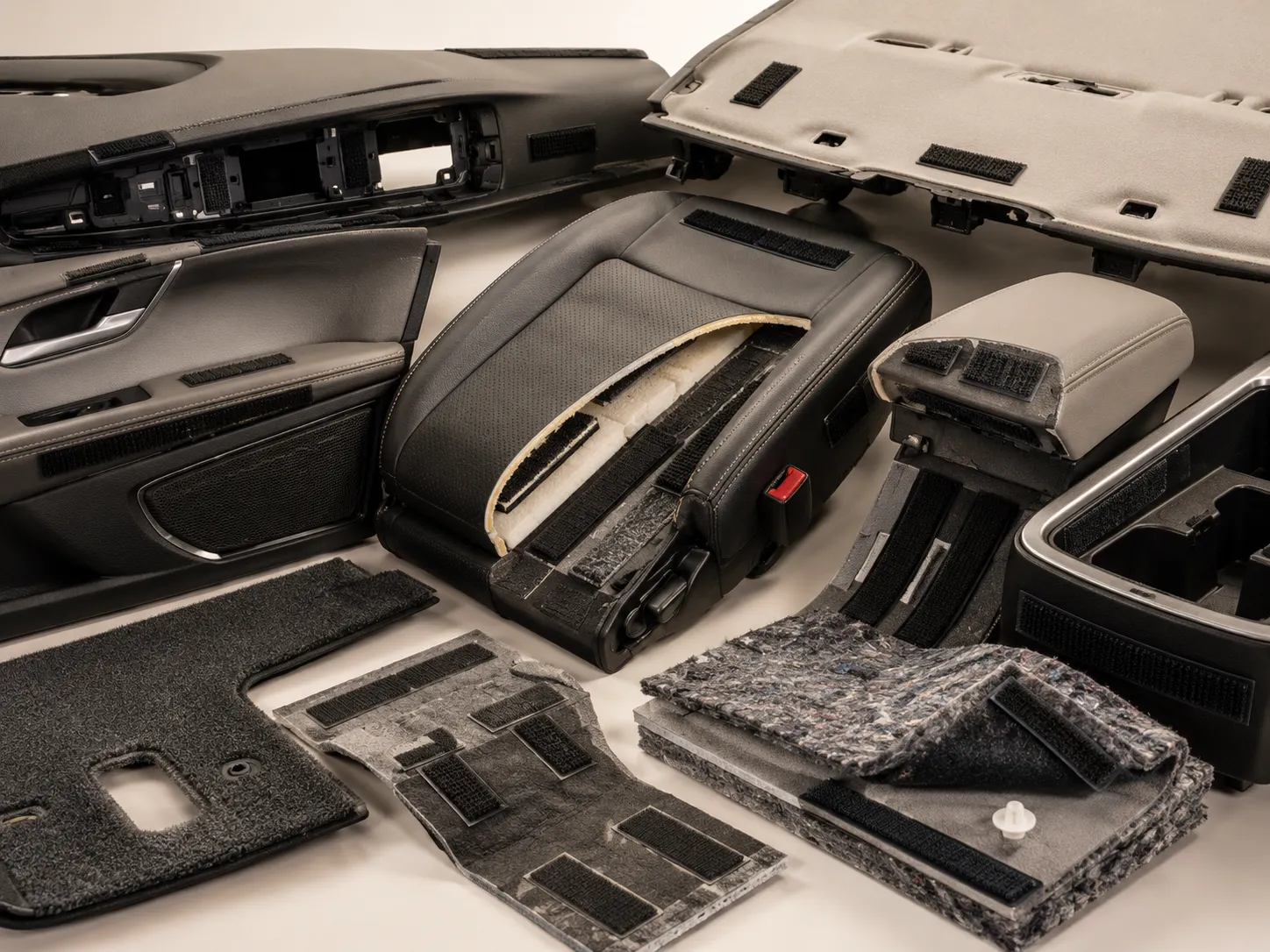
Seat trim and upholstery fastening
Seat trim is one of the most demanding hook and loop applications in the cabin. Bolster covers, side shields, headrest surrounds and seat-back pockets often use hook and loop to create accessible closures that withstand repeated opening and closing during vehicle life.
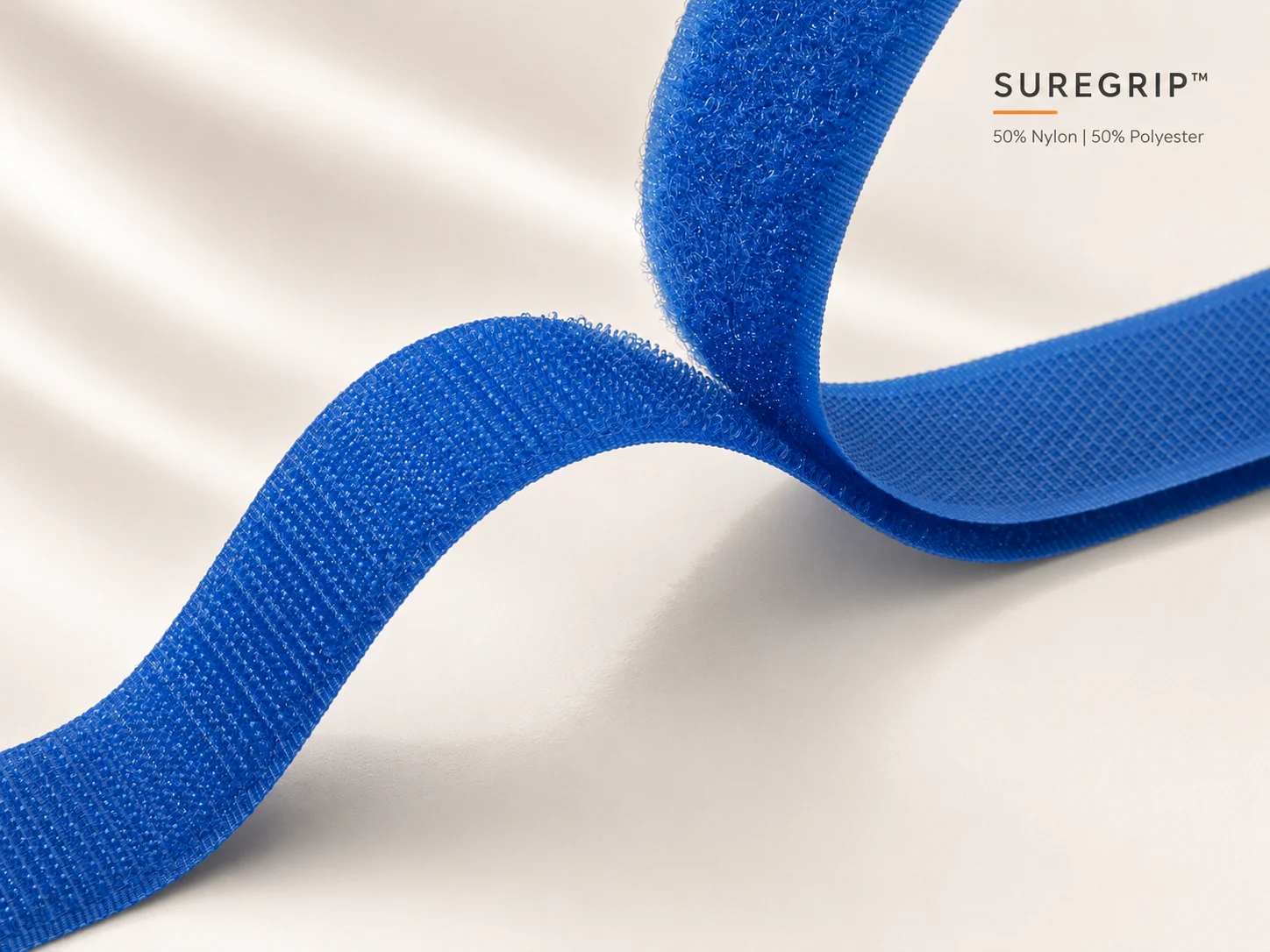
Fabric seat covers typically require sew-on hook and loop. The loop side is stitched into the upholstery panel; the hook side is stitched into the opposing substrate or a hidden flap. This mechanical integration survives the abrasion, flexing and cleaning exposure that adhesive bonds cannot reliably handle on woven textiles. Suregrip, with its balanced 50% nylon and 50% polyester construction, offers stable engagement and moderate moisture resistance suited to sew-on seat trim applications.
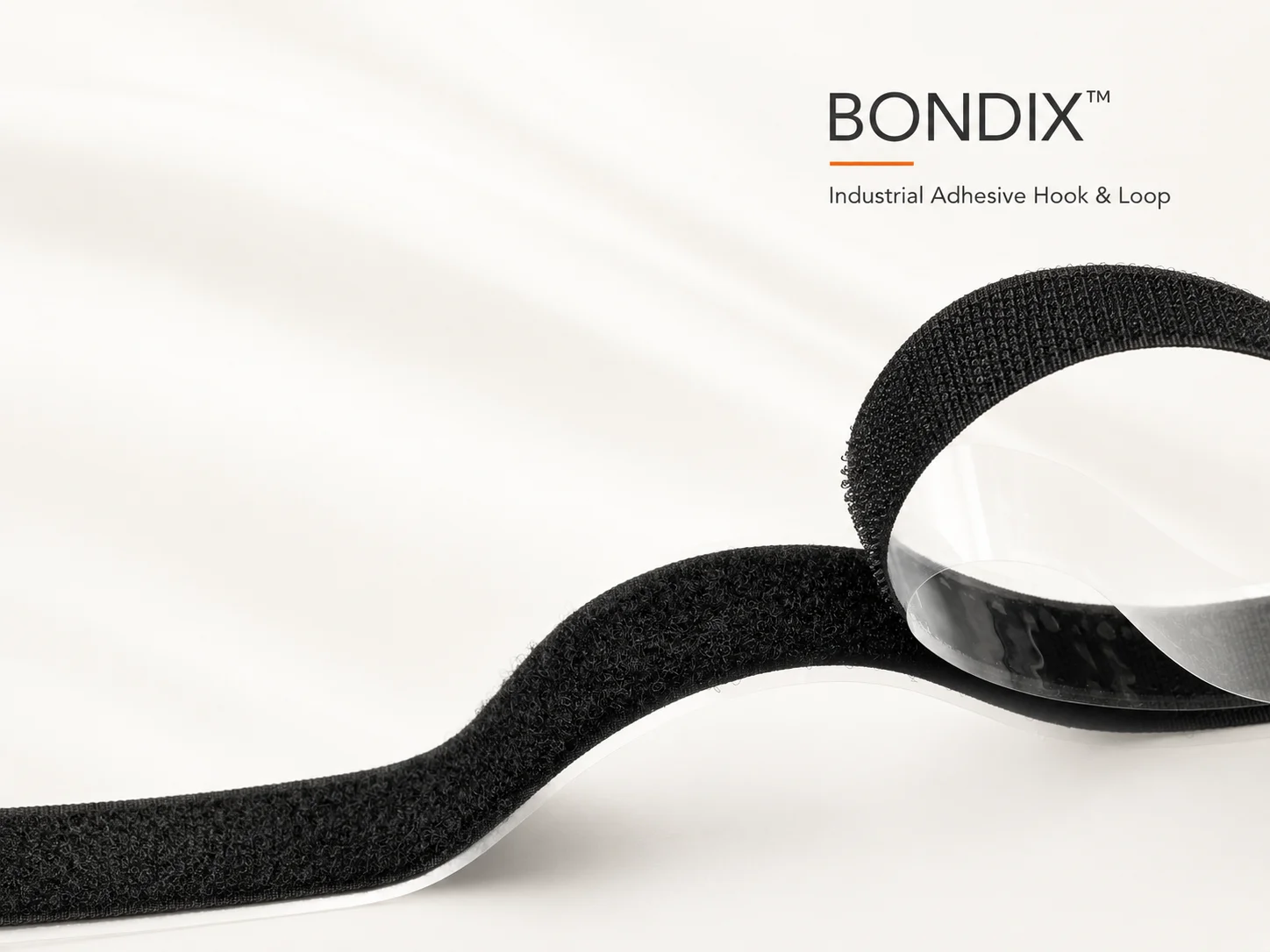
Foam-backed seat panels and plastic trim pieces often use adhesive hook and loop instead. Peel-and-stick placement on PU foam, PP substrates or pre-formed trim shells eliminates a sewing station and supports modular seat builds where sub-assemblies arrive pre-fitted. Bondix industrial adhesive hook and loop is designed for these higher-stress peel-and-stick interior applications where bond integrity must survive cabin heat and handling.
Seat program engineers should specify cycle life targets — commonly 1,000 to 5,000 open-close cycles depending on location — along with color match requirements for visible trim edges.
Headliner attachment and trim integration
Headliners combine a composite board, foam layer and textile face material into a single overhead panel. Hook and loop secures sun visor covers, overhead console surrounds, grab handle trim and wiring harness retention points without penetrating the board structure.
Adhesive hook and loop is the dominant method for headliner work because substrates are typically non-woven textile, foam or rigid board — all of which can accept pressure-sensitive adhesive when surface preparation is controlled. Low-profile tape widths (10 mm to 25 mm) help maintain a flush finish and reduce visible bulging under the face fabric.
Headliner assembly benefits from pre-cut die parts. Operators place hook and loop tabs at fixed positions on the board before the face fabric is laminated, which eliminates measurement steps and alignment errors. Matched hook-loop pairs supplied on a single release liner further reduce pairing mistakes on the line.
Heat exposure is a critical factor. Headliners sit directly beneath the vehicle roof panel, where solar loading can push local temperatures well above ambient cabin levels. Acrylic adhesive systems generally outperform rubber-based adhesives in sustained heat, but the final selection should be validated against the OEM temperature profile for the specific mounting location.
Carpet mats and floor retention systems
Floor carpet mats use hook and loop in a distinct configuration: the hook side is often bonded to the vehicle floor carpet or a retention plate, while the loop side is integrated into the underside of the removable mat. This orientation lets the aggressive hook side grip the OEM floor carpet pile without damaging the mat surface that faces the occupant.
Mat retention demands moderate peel strength with reliable re-engagement after repeated removal for cleaning. The fastening must hold the mat during driving — including emergency braking — without creating the stiff, bulky feel of mechanical retainers. Hook density and tape area are tuned to balance retention force with easy removal.
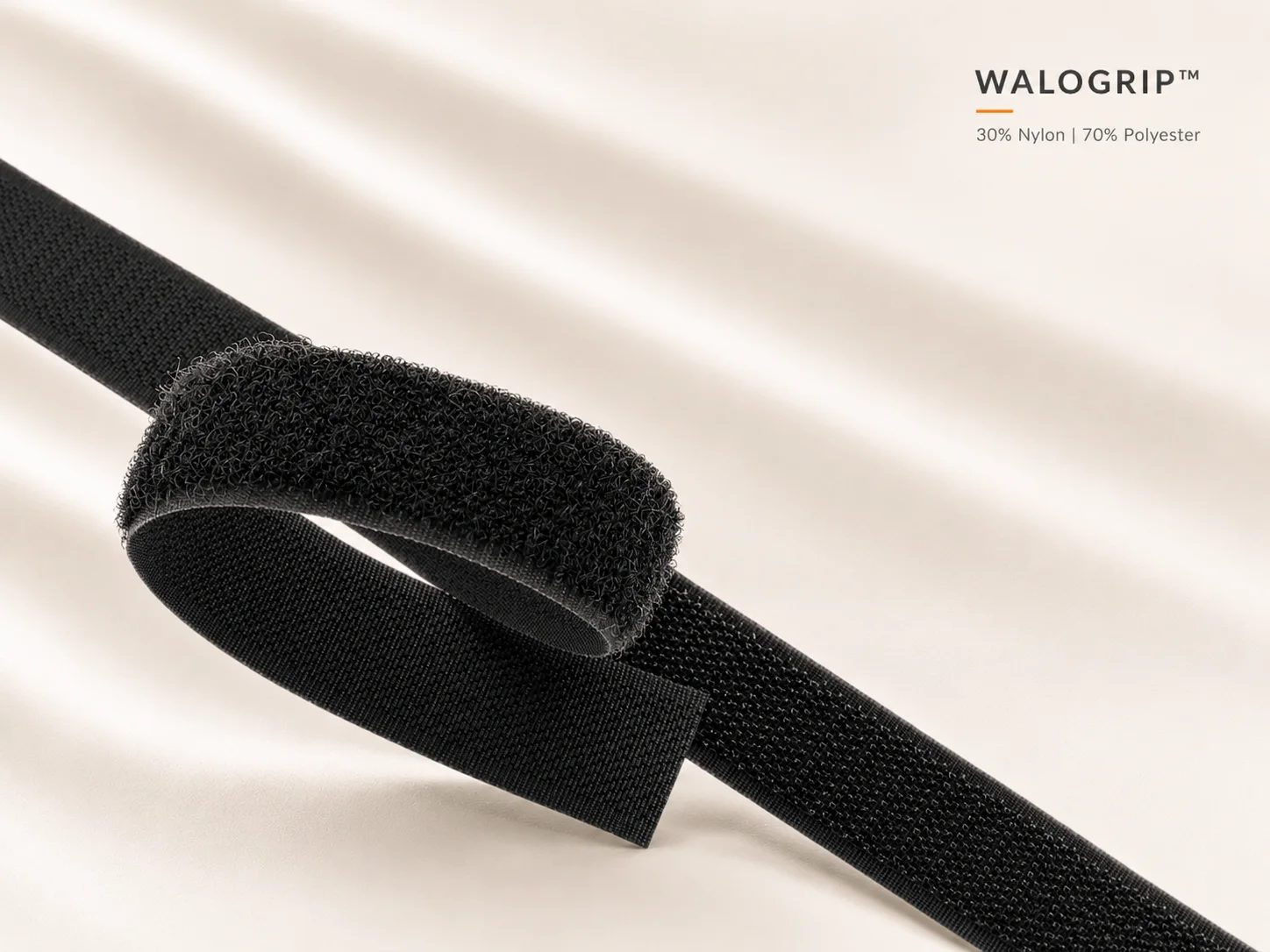
Walogrip is well suited to carpet mat and high-volume interior sub-assembly applications where economical fastening with dependable closure performance supports large production runs. Its 30% nylon and 70% polyester blend offers good moisture resistance for floor-level exposure.
Mat programs should also consider dirt and moisture ingress on loop surfaces, which can reduce engagement over time if loop zones are not protected.
NVH considerations for interior fastening
Noise, vibration and harshness (NVH) engineering shapes many interior fastening decisions. A clip that is slightly loose can buzz at specific resonant frequencies. A screw boss can transmit road noise through a plastic pillar trim. Hook and loop, when properly specified, offers a compliant textile interface that can damp micro-movement without hard rattling points.
Hook and loop is widely used to secure NVH insulation pads — felt, foam and multilayer damping materials — behind door panels, beneath carpets, inside dash assemblies and behind quarter trim. The fastening holds the insulation in position during assembly and vehicle life without the stress concentrations that mechanical fasteners create in soft materials.
However, hook and loop is not automatically NVH-neutral. An over-specified tape with excessive stiffness can create a localized stiff spot in a trim panel. Inadequate bond area can allow insulation pad flutter, which generates the very buzz the pad was meant to prevent. Low-profile, consistent-engagement tape with adequate contact area is the engineering target.
NVH teams should evaluate fastening samples in component-level buzz-squeak-rattle tests alongside the full trim assembly.
Heat and humidity performance in cabin environments
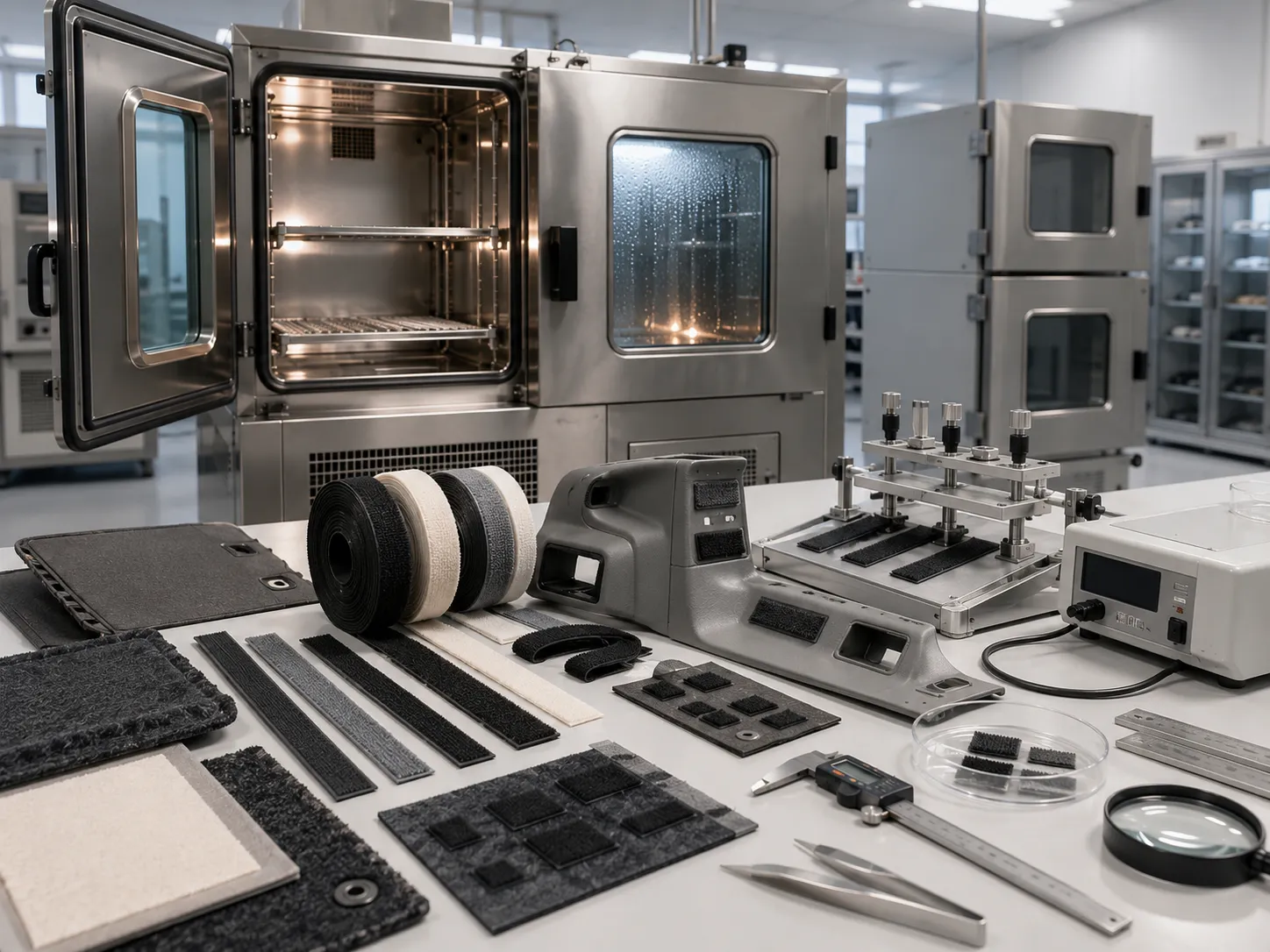
Automotive interiors experience one of the broadest operating environments of any hook and loop application. Cabin temperatures range from below freezing in cold climates to above 80°C in vehicles parked in direct sun. Humidity cycles from dry heating air to tropical moisture loads. Adhesives and textile fibers respond differently to these conditions.
Rubber-based pressure-sensitive adhesives bond quickly and perform well in moderate temperatures, but can soften under sustained cabin heat near headliners, instrument panels and window-adjacent trim. Acrylic adhesive systems maintain bond integrity across a wider temperature range and generally resist humidity-induced degradation more effectively.
Textile material choice also affects humidity performance. Nylon hook and loop offers high engagement strength but absorbs moisture and can lose some closure force in humid conditions. Polyester fibers resist moisture more effectively. Blended constructions — such as the nylon-polyester ratios in Suregrip and Walogrip — balance strength with environmental stability for interior service.
OEM validation typically includes accelerated aging, heat aging, humidity exposure and thermal shock testing. Suppliers should provide test data and support sample evaluation under the customer's specific environmental protocol — not generic laboratory conditions alone.
Adhesive vs sew-on fastening in automotive programs
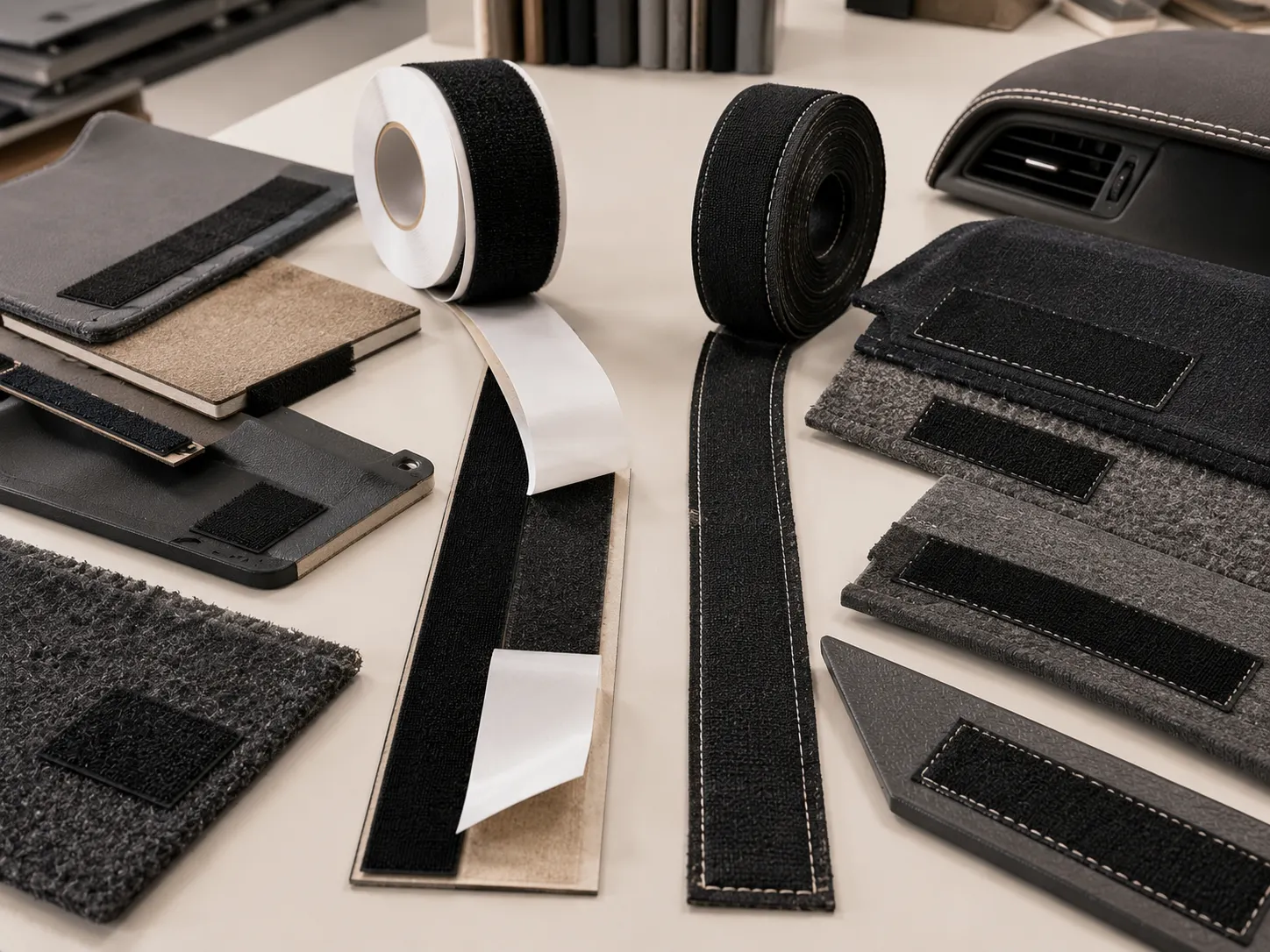
Most automotive interior programs use both adhesive and sew-on hook and loop on different components within the same vehicle. The choice depends on substrate, access requirements, cycle life and whether the attachment must survive textile washing or dry cleaning.
Adhesive Hook & Loop
Sew-On Hook & Loop
Peel-and-stick on PU foam, headliner board, ABS and PP panels with validated surface prep.
Fabric, vinyl, leather and textile composites where mechanical integration is required.
Peel, position and press — no needle setup or thread management.
Requires sewing station, pattern alignment and seam inspection.
Moderate; bond area and adhesive type determine durability.
Mechanical stitching supports high open-close cycles on seat covers and pockets.
Adhesive chemistry must be validated for location-specific temperatures.
Textile attachment is less sensitive to adhesive softening under cabin heat.
Headliners, foam trim, NVH pads, plastic panel mounting.
Seat covers, armrest textiles, sun visor fabric, door panel upholstery.
Misaligned adhesive parts can often be lifted and replaced before final cure.
Stitch removal damages substrate; rework is slower and costlier.
Many Tier-1 suppliers standardize on one sew-on product and one adhesive product per program to simplify procurement and reduce validation scope. The comparison above helps teams assign each product to the correct component family early in the design phase.
Tier-1 supplier specifications and documentation
Automotive interior hook and loop is governed by customer-specific material specifications, not generic textile standards alone. Tier-1 suppliers must document and trace every fastening material through PPAP submission, IMDS reporting and incoming quality control.
Typical specification parameters include peel strength (90° and 180°), shear strength, engagement and disengagement force, cycle life, operating temperature range, adhesive type, textile composition, color, width tolerance, thickness, flame retardancy class and packaging format. Die-cut dimensional tolerances and release liner type are also commonly specified for automated or manual placement lines.
Consistency across production lots is critical. A hook and loop batch with slightly different engagement force can pass incoming inspection but fail on the assembly line when operators notice changed hand-feel or alignment behavior. Reputable suppliers maintain controlled manufacturing parameters and provide certificate of conformance (CoC) documentation with each shipment.
Global programs may require REACH, RoHS and VOC compliance alongside region-specific flammability standards.
Flame retardancy and cabin safety requirements
Automotive interior materials must meet flammability requirements that vary by OEM, component location and market region. In North America, FMVSS 302 is the baseline horizontal burn test for interior materials. European and Asian OEMs often apply their own equivalent or more stringent standards.
Hook and loop, as a textile fastening component, is subject to these requirements when used in passenger cabin zones. Depending on the specification, suppliers may offer inherently flame-resistant polyester constructions, post-treated FR hook and loop, or standard constructions validated to pass the required test when mounted on the approved substrate.
Important nuance: hook and loop may pass a flammability test on one substrate and fail on another because the substrate influences flame propagation. Testing should reflect the actual lamination or mounting configuration used in the finished component — not the tape in isolation on a generic test fixture.
Documentation should include test reports with clear identification of the tested construction, substrate, thickness and any lamination conditions. Lot traceability links each production batch to its test validation, which is essential for audit readiness on automotive programs.
Assembly efficiency on interior production lines
Hook and loop contributes to assembly efficiency in automotive interiors through step reduction, modular sub-assembly and lower tooling dependency. These gains are most visible on high-volume programs where seconds per vehicle translate directly into line capacity.
Peel-place-press workflows. Adhesive hook and loop eliminates sewing machine setup, needle threading and stitch inspection for foam and board applications. An operator can apply pre-cut tabs in a single motion, which is typically faster than mechanical fastening alternatives for the same component.
Modular seat and trim builds. Sub-assemblies fitted with hook and loop arrive at the final assembly station partially completed. Seat trim covers pre-fitted with sew-on tape, headliner boards pre-taped with adhesive tabs, and carpet mats with integrated loop patches all reduce final-line complexity.
Pre-cut and die-cut formats. Supplying hook and loop in exact part geometries eliminates manual cutting, reduces material waste and prevents width variation that causes alignment issues. For a deeper look at how adhesive formats accelerate manufacturing workflows, see the guide on how adhesive hook and loop tape improves production efficiency.
Rework tolerance. Misaligned adhesive placements can be corrected before the final lamination step. This reduces scrap rates on expensive headliner boards and foam trim shells compared with permanently bonded or mechanically fastened alternatives.
Efficiency gains should be measured per workstation with the actual production crew, substrate and environmental conditions — not extrapolated from catalogue specifications alone.
Walonium product recommendations for automotive interiors
Walonium manufactures hook and loop tapes suited to the performance tiers and attachment methods common in automotive interior programs.
Bondix industrial adhesive hook and loop is the primary choice for peel-and-stick interior applications: foam-backed seat panels, headliner board attachment, NVH pad mounting and plastic trim bonding where validated adhesive performance is required.
Suregrip non-adhesive hook and loop, with its 50% nylon and 50% polyester blend, suits sew-on seat trim, armrest textiles, sun visor fabric closures and moderate-cycle interior applications where balanced strength and moisture resistance are needed.
Walogrip non-adhesive hook and loop offers economical fastening for carpet mat retention, accessory panel attachment and high-volume interior sub-assemblies where cost efficiency and dependable closure support large production runs.
Material selection should be reviewed alongside the nylon vs polyester material guide when programs require deeper textile engineering input.
Key automotive interior application areas
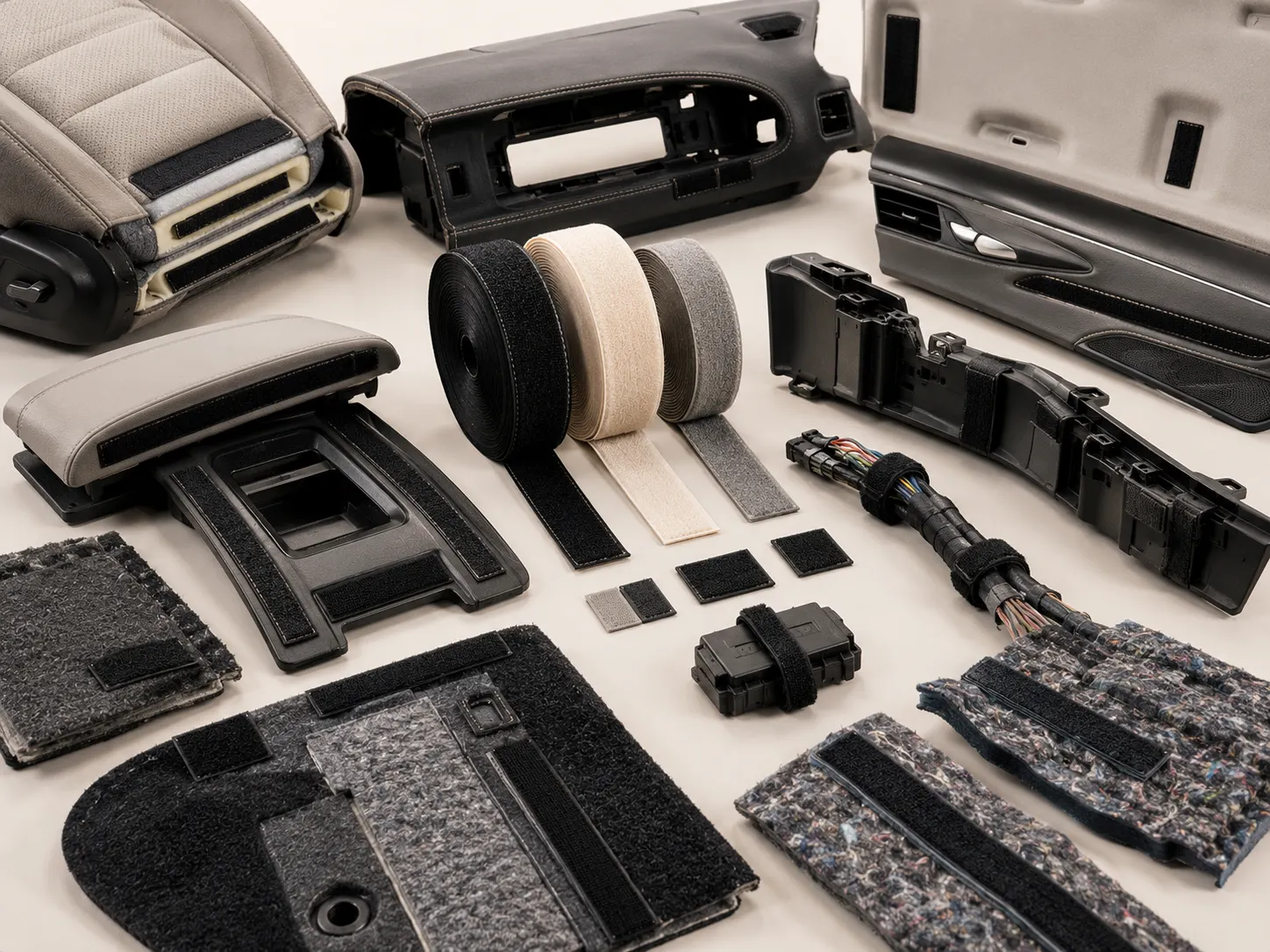
Trim covers and bolsters
Sew-on tape for fabric closures; adhesive tape for foam-backed panels and side shields.
Board and console trim
Low-profile adhesive tabs for sun visor covers, grab handles and wiring retention.
Carpet mat retention
Hook-side bonding to floor carpet with loop patches on removable mats.
Insulation pad mounting
Secure felt and foam damping layers without rattling mechanical fasteners.
Panel and pocket closures
Textile-integrated fastening for map pockets, pull handles and armrest covers.
Armrest and storage lids
Moderate-cycle closures on center console textiles and accessory panels.
Airbag cover access
Controlled-release fastening where specification allows textile closure integration.
Common mistakes in automotive hook and loop specification
The first mistake is selecting tape without substrate validation. Foam formulations, PP glass-fill ratios and textile face materials all affect adhesive bond performance. A tape that bonds well to one headliner board formulation may fail on a substitute from a secondary supplier.
The second mistake is ignoring location-specific temperature exposure. A tape validated for a door panel application may be inappropriate for a headliner position directly beneath the roof skin. Heat profiles vary significantly within the same cabin.
The third mistake is under-specifying cycle life. A tape suited to a one-time NVH pad attachment should not be used on a seat-back pocket that occupants open daily. Cycle life requirements must be defined per component, not per vehicle.
The fourth mistake is treating flame retardancy as a supplier-only responsibility. OEM engineers must confirm the test configuration matches the finished lamination. A compliant tape on an non-compliant substrate assembly still fails the component test.
Buying advice for automotive procurement teams
When requesting a quotation, provide the component drawing, substrate specification, attachment method, required cycle life, temperature zone in the cabin, color requirement, production volume, preferred format (roll or die-cut) and compliance checklist (FMVSS 302, IMDS, REACH, etc.).
For new programs, evaluate Bondix adhesive tape and Suregrip or Walogrip sew-on tape in parallel on the actual component. Document peel strength after heat aging, cycle life after environmental exposure and assembly time on the production line.
Think in total program cost: material price, assembly labor, scrap rate, validation expense and warranty risk. The right hook and loop specification costs more per meter but can reduce total cost of ownership across the program life.
Key takeaways
Hook and loop is a proven fastening solution for automotive interiors when specified for the actual component, substrate and cabin environment. Seat trim, headliners, carpet mats and NVH insulation each demand a tailored approach to material, adhesive and attachment method.
For Walonium buyers, the practical mapping is: Bondix for industrial adhesive interior fastening, Suregrip for balanced sew-on trim applications, and Walogrip for economical high-volume interior fastening.
Validate every specification under OEM environmental protocols, confirm flame retardancy on the finished lamination and document materials for PPAP and IMDS before scaling to production volume.
FAQ
Where is hook and loop used in automotive interiors?
Hook and loop is used in seat trim covers, headliner attachment, carpet mat retention, armrest panels, door trim, sun visor covers, seat-back pockets and NVH insulation layers. It supports removable panels, serviceable components and faster assembly on Tier-1 interior lines.
Should automotive interiors use adhesive or sew-on hook and loop?
Adhesive hook and loop suits foam-backed substrates, plastic panels and quick peel-and-stick assembly where validated bonding is acceptable. Sew-on hook and loop is preferred for fabric seat covers, high-cycle closures and applications where mechanical permanence or wash durability is required. Many programs use both methods on different components.
How does heat and humidity affect hook and loop in vehicles?
Cabin temperatures, solar loading and humidity cycles can soften adhesives, affect peel strength and accelerate fiber fatigue. Polyester-blend textiles resist moisture better than pure nylon in humid climates. Acrylic adhesive systems generally outperform rubber-based adhesives in sustained heat. Validation testing under OEM temperature profiles is essential.
Does hook and loop affect NVH performance in automotive interiors?
Hook and loop can contribute to NVH performance when used to secure insulation layers, damping pads and trim without rattling hardware. Poorly specified tape with excessive stiffness or inadequate bond can create buzz, squeak or panel movement. Low-profile, stable-closure specifications help maintain acoustic integrity.
What flame retardancy requirements apply to automotive hook and loop?
Automotive interior materials often must meet OEM-specific flammability standards such as FMVSS 302 or equivalent customer tests. Hook and loop suppliers should provide test reports, material composition data and lot traceability. Flame-retardant treatments or inherently FR textile constructions may be required depending on component location and OEM specification.
What do Tier-1 suppliers specify for automotive hook and loop?
Tier-1 specifications typically include peel and shear strength, cycle life, operating temperature range, adhesive type, color match, width tolerance, die-cut format, PPAP documentation, IMDS material data and flammability compliance. Consistent roll quality, controlled elongation and stable engagement force across production lots are also critical.
Which Walonium products suit automotive interior applications?
Bondix provides industrial adhesive hook and loop for foam-backed panels, trim attachment and peel-and-stick interior assembly. Suregrip offers balanced nylon-polyester performance for sew-on seat trim and moderate-cycle closures. Walogrip delivers economical fastening for carpet mat retention, accessory panels and high-volume interior sub-assemblies.
How does hook and loop improve automotive assembly efficiency?
Hook and loop reduces assembly steps by replacing drilling, clipping or multi-stage sewing with peel-place-press attachment or single-pass stitching. It supports modular seat builds, faster headliner fitting, repositionable mat placement and simpler service access. Pre-cut die parts and matched hook-loop pairs further reduce line handling time.